


Future Legal Leaders Found Stetson NBLSA Chapter

Five percent of U.S. lawyers are African American according to a 2024 report from the the American Bar Association. To Temi Adediji, ‘27 and Collin Hughley ‘27, these numbers are reflected in the lack of diversity in Stetson’s pre-law program.Back in January 2025, Hughley scrolled Instagram and realized that his future career prospects have expanded, leading him to Fall Semester 2025, where his goal to change the lives of future attorneys would take root at Stetson.
Hughley, a double major in political science and religious studies, was inspired when he saw that fateful post from a former speech and debate opponent he had competed against in high school. This competitor was elected as the president of the University of Central Florida’s Pre-Law Chapter for the National Black Law Students Association (NBLSA). Motivated by what he saw, Hughley raised the idea of starting a pre-law chapter of the NBLSA at Stetson toTemi Adediji, ‘27 and alumna Tori Watson ‘25.
“When [Hughley] brought the idea to me, I was immediately on board. I was ecstatic, because I knew that it was something that Stetson needed and I knew that it was something that Stetson would benefit from,” Adediji said. With the support of his peers along with Lila Jaber and Simone Marsteller – current and former board of trustee members, respectively – Hughley was able to get into expedited contact with the NBLSA. Now, Hughley and Adediji are beginning their second semester as co-presidents of the Stetson NBLSA Pre-Law Chapter.

Along with the organization name, Hughley and Adediji intentionally bring the national mission of the NBLSA to Stetson. The core values of the NBLSA consist of promoting culturally responsible black and minority attorneys who excel academically, exceed professionally and impact their communities. Looking back on the semester, Adediji highlighted some achievements that contributed to this mission.
Adediji’s expectations for involvement were pleasantly surpassed. His expectation of five-to-ten members was exceeded when about 25 members joined the organization, which is the biggest accomplishment in his eyes. “Students came in from left and right and they really, really, bought into BLSA’s mission,” Adediji said. The organization has also had networking opportunities through their newfound connection with the Virgil Hawkins Florida chapter of the National Black Bar Association – which consists of a network of over 1,500 attorneys statewide. They also took part in an initiative put on by the southern region of the NBLSA called “Letters of Love.” As part of this initiative, Adediji described a competition to write the most letters to people in need, including the incarcerated, people experiencing poverty and children in foster homes. Stetson’s chapter won the contest, writing about 200 letters. “To me, that was a very meaningful accomplishment, because it just showed me that what we brought to Stetson, it is doing exactly what we hoped it would do,” Adediji said. “We are creating lawyers who desire to make a difference, who desire to see change.”

Complimenting Adediji’s list of accomplishments, Hughley made the point to further elaborate on what he calls the “personal” side of the organization’s accomplishments. The impact of the organization on student’s lives makes Hughley feel accomplished when he reflects on the past, when it was even more difficult for black law students to excel.
Specifically, Hughley explained how he helped another student get into law school. Hughley described the student as someone who had experienced hardship and was questioning if she belonged in the legal profession. “The [NBLSA] mission statement stuck to my heart, to increase the number of culturally responsible black and minority attorneys. And so I worked [with] and I helped her with her personal statement; I helped her with her application holistically,” Hughley said. “To hear that she got accepted [to law school]...It's one of the reasons why we chartered this chapter.”
In their Instagram bio, the NBLSA defines themselves as a non-profit that “promotes the development of socially conscious future lawyers.” Prompting personal reflection, Hughley and Adediji defined what being “socially conscious” means to them and their roles in this chapter:
Hughley describes being socially conscious as having an awareness “of how race, structural racism and power dynamics in certain institutions – specifically being we’re in undergrad-educational institutions – how they impact minority or African Americans lives via education and community while simultaneously engaging in actions, challenging these systems,” Hughley said. “I think it involves developing a strong but positive racial identity and using that identity to…resist the negative societal stereotypes that exist around our community.”
As he enters this semester, Hughley looks forward to further implementing the NBLSA’s values. “We're all focusing on those three points of their mission statement this semester in our programming. So January is ‘excel academically’, February will be ‘succeed professionally’ [and] March will be ‘positively impacting our community with volunteer work,’” Hughley said. As part of their volunteer work, the organization is also planning for community service at a high school in Orlando.
Adding onto Hughley’s interpretation around awareness, Adediji said, “I think the root of awareness is knowledge, right? I think allowing yourself to be educated and informed on the systems around you and how race and power dynamics factor into those systems, is how you build awareness to the fact that those systems even exist.” As an aspiring law student, Adediji sees consequences in failing to open yourself up to such knowledge. “The biggest danger of failing to be a socially conscious lawyer is that A) you end up perpetuating the very systems that were designed to work against you, and B) you end up losing power just because you don't know what's going on around you.”
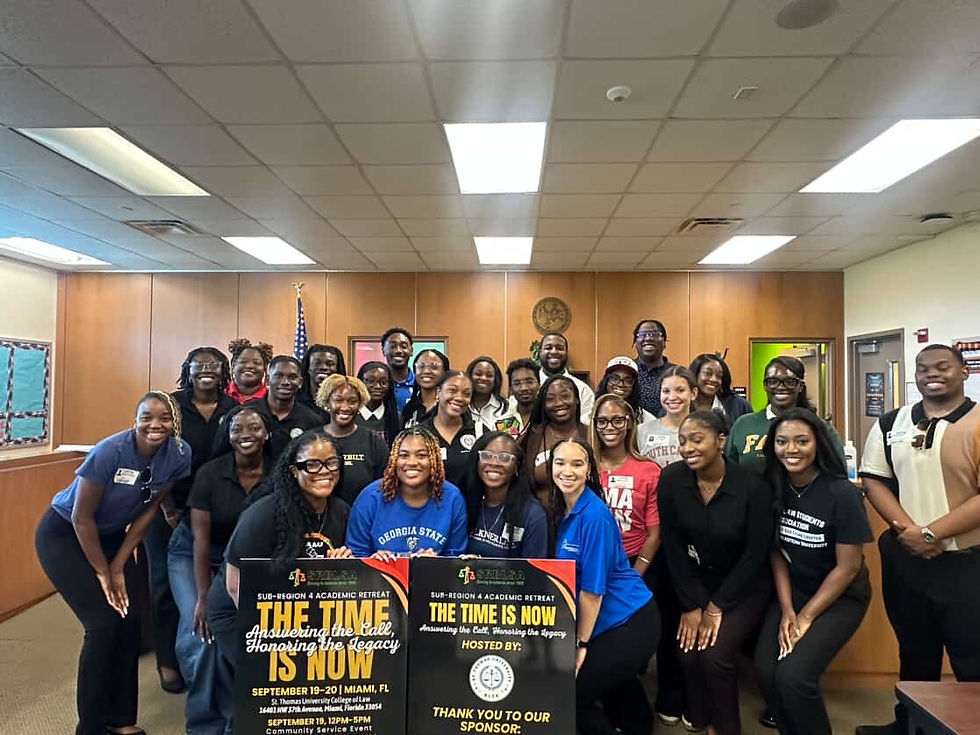
For the club members’ academic development, the co-presidents are looking to implement something they see as lacking at Stetson: a structured LSAT pipeline. “We noticed that at Stetson, there isn't really a curriculum for [reinforcing LSAT preparation]. There's no courses. There's no professors who necessarily teach about the LSAT,” Adediji said. Stetson’s NBLSA chapter is looking to change this and their first step is bringing in former Hatter Tristyn Rampersad ‘25, who Adediji says received a great LSAT score, to give an introductory course on the LSAT to students. “I know when we were freshmen, we were ignorant to the LSAT and its importance, Adediji said. “And it's very important as pre-law students that we know exactly what we're working towards and how to best prepare for it, because the earlier you start preparing, the better that you'll succeed.”
When pondering their legacy after they graduate in 2027, the co-presidents hope that they have laid the foundation for the future success of the organization, including a potential endowment of the organization so it can grow even further. Hughley hopes that the underclassmen on their executive board will step into higher leadership positions and that the cycle of growth in the organization can continue. “It'll just be a continuous cycle of helping black and minority students get into law school. That's our simple goal,” Hughley said. Adediji hopes that the organization will remain at the university to continue to uplift diversity on campus. “It wasn't too long ago that Stetson was the opposite of a diverse institution. We all know that Stetson's a PWI, but it wasn’t very long [ago] that we didn’t have a lot of diversity at Stetson,” Adediji said. “So this organization is something that means a lot to a lot of people and I know for both of us, it's something that we want to live long after us.”


Comments